Strains: Learning Disabilities and the Traditional Education System

In the Social Platform podcast and blogs and in the YouTube video, personal stories are conveyed more often than factual reports. The Podcast relates stories about individual family experiences with learning differences. Questions about teaching to dyslexics are raised and answered; individual cases are discussed. The blog posts often a similar kind of venue. Personal stories are part of every blog posting. The YouTube video tries to teach what it feels like to be dyslexic through a story using cartoon characters. What all of these sources help us to understand is how real the problem is and how those in the dyslexia community are trying to improve the experience of education. 

https://www.dyslexicadvantage.org/category/social-and-emotional/

https://www.apmreports.org/story/2017/09/11/hard-to-read


If It’s Broke, Fix It: Tackling Situational Depression Through Social Justice

After compiling the platforms and videos a multitude of possibilities for courses of action to take arose. All of the links and sources detail the same issue, the importance of addressing and even just naming the issue of mental illness, especially for the youth in this country is immense. Much like Ruby Wax said, the statistics could easily change to 4/4 affected Americans should nothing be done.

Michael Marmot also details the most descriptive and inclusive strategy for enacting social change that not only creates healthier generations today, but also addresses the structural root cause of the problem within society to make healthier generations of tomorrow as well. His work combined with the use of the framework outlined by the US Department of Health Services provides the clearest ‘next steps’ that I could take in creating a plan to fix or begin fixing my issue.

Such first steps are illustrated and currently being done by those at the Young Minds Advocacy Organization that offers great, detailed resources for ways to get informed, involved, and seek help.

I plan to dive deeper into combining all of the sites I’ve found so far to create one, all-encompassing way to focus and work on the issue at hand.

– tf

Beware of the Epidemic

The FDA’s recent decision to ban the flavors of Juul pods has been through the work of the public sphere. This is an example of how public activism can have a strong effect on the government and on corporations.

Change can be made if people come together to voice their opinion on societal issues.  In addition, many advocacy groups and government organizations have done work to inform the youth about the dangers of picking up a Juul. One hit of a Juul can instantly create an addiction like any other product that contains nicotine.

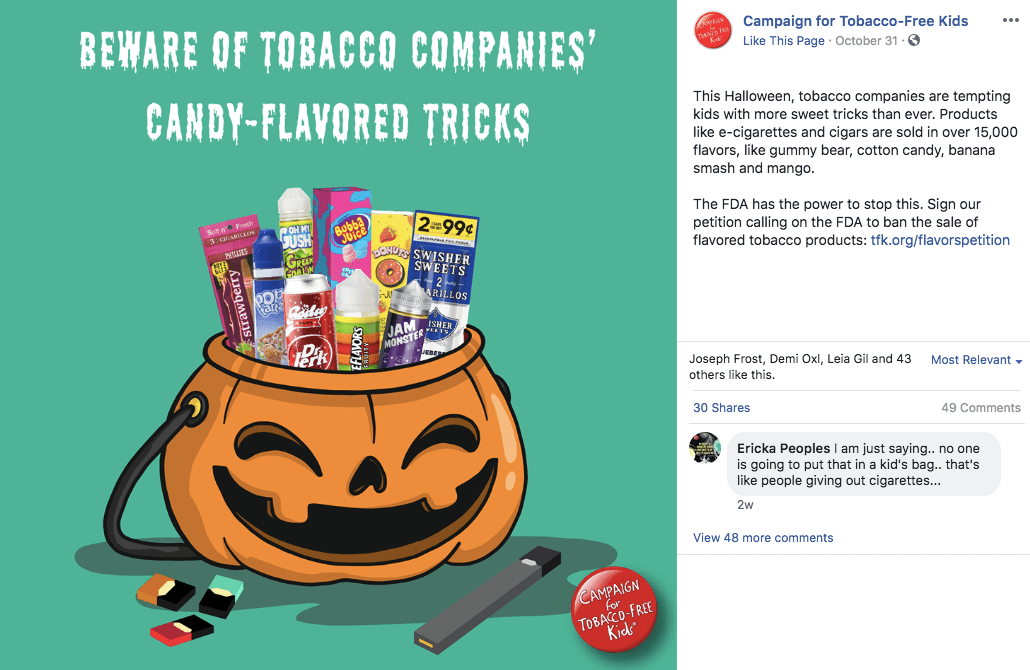
Screen Shot 2018-11-15 at 3.20.21 PM
Screenshot from the Campaign for Tobacco-Free Kids Facebook page to inform teens on how Juul and other e-cigarette companies target youth consumers.

By tightening up legislative laws, informing teens, and making Juuls less appealing to the youth consumer, it can ultimately led to Juuls being only used by people who want to end an addiction and not by teens who are clueless and will bring one upon themselves.


-S.L.

“Crazy, Black and Poor”; Breaking the Stigma

https://www.youtube.com/watch?v=0qIrBtgUC80

Jessica Clemons a black psychiatrist using her platform to change the perception of black mental health is truly inspiring. Through social media using Instagram live she provides an alternative for those who may not be able to afford the help of a psychiatrist and answers questions surrounding mental health and wellness. Through this platform Clemons educates, and supports mental health while providing a digital space for black people to learn, grow in breaking the stigma and identifying root causes.

Kimberly Brazwell took an interesting approach by using a poem “Crazy, Black and Poor” to lead off in discussing the many dangers in stigma regarding mental health and denial of trauma as someone who grew up in a low income neighborhood. Brawell offers an analysis that promotes defining things correctly and speaking truth so untreated mental health and trauma does not permeate in socially, physically and emotionally.

The Black Mental Health Coalition is campus run organization, raising awareness regarding mental health and breaking the stigma through discussion, solidarity and useful tips. By providing stories of way in which mental health and blackness is not discuss their platform online has become a tool of support and awareness. Through meetings, tips and discussions surrounding mental health they are broadening the scope and breaking the stigma.

  • J.H.


Social Media and it’s Effect on our Mental Health

Social media is like a drug to us- addictive. We are all extremely dependent on it- getting relief out of receiving the right amount of likes, making sure all notifications are checked, etc. This addiction starts young, along with the deterioration of mental health due to it. Children in grades 7-12 who spent over 2 hours a day on social media reported higher depression, anxiety, and suicidal thoughts.

Bailey Parnell addressed all of the issues that run through our minds while on social media, and she highlights how addictive it is to be in the loop with everyone else. She also shows how many of us consider deleted our social media platforms, but never do. Why is this so similar to a drug, and how can we put an end to this problem. For the most part, the people who are most present on social media have been on it for their whole lives, including myself. Living in this online world had led to many problems, and the next step is to figure out a way to stop it before it gets even worse.

Start the Taboo Discussion

There is a correlation between mental health issues and the LGBTQIA community. 

Mental disorders are often portrayed in the entertainment industry in a negative light or follow a stereotypical image, similar to the way the LGBTQIA community is represented. 

Those who are not portrayed in the entertainment industry feel further isolated and lack the understanding of the disorders or communities they identify with. By bringing accurate knowledge and representation of mental health issues and the LGBTQIA community to schools, news and media, organizations have allowed stigmatized topics to become less taboo.

The New Addiction

Juuling and e-cigarette use has become an addiction within youth culture over the past year or so. Juul and other vape companies are becoming the new and revamped “Big Tobacco” companies by targeting kids at a young age.

The slim USB looking design makes it easy to hide and fruit/candy flavors appeal to kids who have adopted the idea that it is trendy to own one. It has also become popular on social media sites for youth to post videos of themselves doing tricks with the vapor. Many kids think it’s safe to consume because they believe they are just inhaling water vapor, but in fact, Juuls contain the same amount, if not more nicotine than a traditional cigarette. According to the Juul website, the devices create an aerosol rather than using a flame to activate the ingredients. The company says the product produces a level of nicotine similar to a traditional cigarette in order to satisfy cigarette smokers who switch to vaping” (Zernike, 2018, New York Times). 

The companies who make these products claim to help cigarette smokers quit their addiction, but at the same time they are starting an addiction for kids who have never smoked before.  Many companies, like Juul are in denial that their products are specifically targeting young kids and that it is not their fault that youth are becoming attracted to the idea of owning a Juul.

Government agencies (FDA) as well as activist groups have  pushing for change of the purchasing age, as well as production and marketing of Juuls to make them less kid friendly and more for the purpose of what the actual aim of the product is, which is helping former smokers quit smoking tobacco products.  Recently (a few days ago), the FDA announced that they will place a ban on the selling of flavored Juul pods with the exception of mint and menthol flavors. They will also set forth age verification tactics so that it will be hard for underage consumers to buy the flavor pods online. The question that remains is will this ban be successful in keeping minors away from purchasing Juul pods or will they still find a way to get these pods from a third party source?

-S.L.

Ableism and the Stigmas of Learning Disabilities

The three annotations all point to the added stress and labor required of students who have learning disabilities. Not only do these students have to spend more time and effort doing tasks like reading and language processing (in fact, it takes them as much as five times as long as students without learning disabilities), they also have to work in a broken and limited system. They feel stigmatized by their peers, misunderstood by their professors and neglected by the school administration. These students’ families end up paying thousands of dollars for testing and necessary supports which in turn puts them at an economic disadvantage. Many families have to take out loans. Without proper testing and documentation, students cannot receive supports in school. Therefore, only well-off families can give their kids the supports they need.

If one in every five students has a learning disability, as states the National Center of Learning Disabilities, then we as a society are discriminating against one in five of the student population. The popular press articles are not ready to discuss the stress disabled students experience; they are more eager to talk about the increased burden disabled students place on the educational system. Therefore, there needs to be more public advocacy and awareness of the mental and emotional disabled students suffer from on a daily basis.

Unique and Substantial Challenges in the Black Community

The articles I have researched outline the contributing factors of mental health in black communities.

Through narratives, statistics and policies we see the ways in which historically, communities of color have experienced  unique and substantial challenges in accessing mental health services and adequate responses to addiction and trauma.

Moving forward these platforms offer solutions such as fundamental transformation of the system that acknowledges trauma in context to one’s environment. Educational outreach is also at the forefront of a root solution outlined in the articles researched and acknowledging existing disparities is essential to moving forward with the mental health and addiction in black communities.

  • J.H.

Deteriorating Mental Health: A Symptom of Society

From the small amount of research that has been done so far, the results of my exploration into the issue of mental health’s root causes and solutions in today’s society have been astounding. I set out with the intention of finding a select few, articles detailing how certain issues could affect mental health. However, I ran into countless journals, databases, articles, and blog posts detailing how this issue, of structurally caused degradation of mental health, is very much a real thing and is much more than just a proposed thesis.

The structure and values of our very society creates, stimulates, and enables the mental health issues we see so prevalent today. All articles I’ve found pinpoint and illustrate the same picture, of a crumbling collective and how this affects the individual within it. I also found the current status of the issue to be even worse than previously thought, as suicide rates climb and the upcoming youth’s mental health deteriorates. Our current society breeds insanity, anxiety, and depression from the structure of our health administration, to the erosion of communities, to the embedding of social media within our daily life. Our societal institutions lack enthusiasm, empowerment, autonomy, diversity, and autonomy. All things which are touched upon in a multitude of the articles found.

However bleak this situation may seem, much like social critic Lewis Mumford wrote in his analysis of the perfect ‘functioning’ society, “little hope is still some hope” (Mumford, 1945). While the articles all helped me realize the brevity and increasingly worse conditions on the issue of mental health within society, they also provided me with possible routes and roadmaps to enacting social change. Through social group activism with organizations like the National Alliance on Mental Health, to how to build a supportive community that addresses and heals the issue through connection instead of repression. I’ve luckily been granted insight into directions for change and my following post will go further in depth regarding how to transform what society has dubbed an individual issue, into collective action.