- Teyah Fasheh and Hannah Walsh
Exploring Root Causes and Strategies for Social Change
What are we not talking about?
How come mental illness is so taboo in certain communities?
Can the suppression of these disorders worsen the illness?
How can we begin the discussion?
– Illustration by Emily and Jada
“Restrictions being placed on Juul are faster than gun control.”
“A juul in your hand is equivalent to having an iPhone.”
“Abled does not mean enabled. Disabled does not mean less abled.”
“You don’t improve education by demoralizing the people that have ton do the work every day”
-Samantha Lassman & Uriel Tyler

Cancer. Car accidents. Heart attacks. Suicide. What do all of these afflictions have in common? They’re the leading causes of death in the US, however, only one is on the rise. Suicide, now three times as common as murder, has risen steadily in almost every state since 1999 and by 25% nationally . Of this rising rate, nearly 50% of the US population will suffer a mental health disorder at some point. Even worse, these numbers are affecting us younger and younger.
Representing just one staggering statistic of many others, the issue of suicide is quickly becoming a national epidemic that’s indoctrinating victims at increasingly younger ages. Bluntly put, youth mental health is worsening as well. The average age of those experiencing onset depression has lowered steadily from 29.5 years old to the current age of 14, meaning it has lowered every year, by a year, for over a decade. Now, kids only half the age of their parents, are experiencing the same pressure and emotional distress that fully grown adults have a hard time handling. Additionally, the percentage of American children experiencing not just a bout of depression, but a lifetime, of depression and anxiety issues has risen over 3%, to 8.4 in less than 10 years.
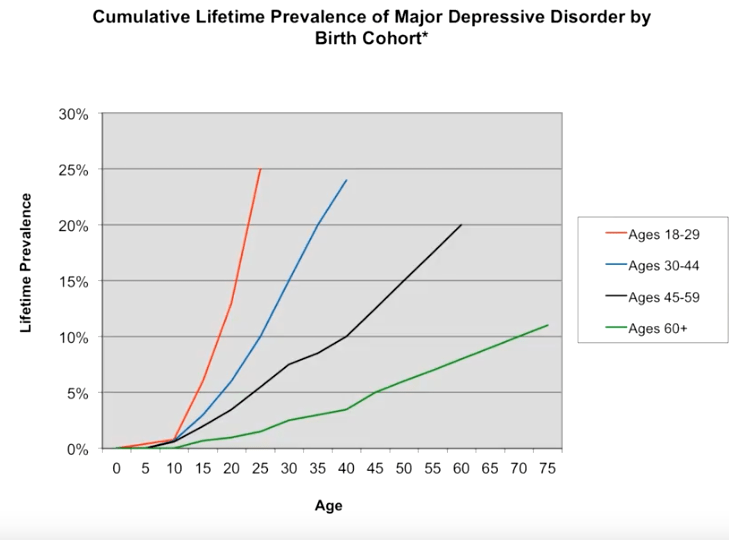
All of these statistics are reiterations of the same fact, the problem, of youth mental health and the treatment of this issue across America, is only growing worse. Every generation for the past decade has lowered the age at which we begin experiencing mental health issues, while also increasing the longevity and duration of its stay among us. What could explain this? Why now? Why are we becoming more and more miserable by the day? Why is suicide projected to become one of the leading causes of death in our country? While there is no simple answer, there can be a root cause – society itself. Our shared societal experience is the common factor that connects all statistical dots. However, this issue of increasing depression among youth and climbing suicide rates is still being treated and made into an individual biological problem, a personal chemical imbalance, rather than as what is the very real presence of what is socially caused depression.
There is more than just one type of depression, not just a chemical, serotonin imbalance, but rather a symptom of society. A society that “erodes communities and isolates people, which [ours] does in major ways”, is going to breed insanity. This presence of structurally caused, societal depression is supported by the fact that more than half of those who commit suicide didn’t have any ‘known’ mental health conditions, instead “had other problems – loss of relationship, financial setbacks, eviction, job loss”, etc… A fact largely supported by the fact that suicide rates climb to new heights at societal lows. During the Great Depression for example, the rate was 22 and according to the most recent CDC data, the current rate has climbed to 15.4 this past year alone. Therefore it can’t just be a chemical imbalance making us all genetically born more depressed- evolution just isn’t fast enough to account for this and the numbers are far too high.
Instead, it is largely due to the fact that modern society has failed our most basic human needs. We are “disengaged from our jobs and our schooling”. The high prevalence of youth mental health issues is allotted to the increasing pressure placed on them, like amassing loan debt and acquiring the credentials just to get a job for which they have no enthusiasm. This pressure combined with the disengagement of the collective has created an increasing amount of people socially isolated from one another.
Society’s impact on structurally breeding these issues doesn’t stop at the pain of debt or schooling, the aforementioned pain of isolation is the worst effect of all. The American Sociological Review published a 2006 study, “Social Isolation in America”, which found that the percentage of Americans with a personal confidant in their lives had decreased by 15% over the course of the decade. Psychologists and social anthropologists alike have attributed these effects to our societal institutions that are lacking the very basic principles that we, as humans and as a society, need to survive as social creatures.
Our societal institutions lack enthusiasm, community, trust, empowerment, autonomy, participatory democracy, diversity, and stimulation (just to name a few). Instead, society is left not “humanly interesting” and out of this, can only produce a “mass man”, who is incapable of self-directed activities and disciplined to “monotonous work”. A mass man representing entire generations of youth and those before us, conditioned to be miserable in the shackles of our uninteresting societal constraints.
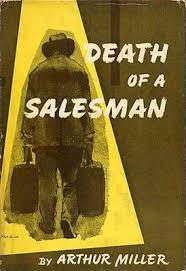
We’re constrained by social stress and lack of community stemming from a society that teaches us our core values are money and status, all under the guise of innovation and progress. Industrial and modern development under the capitalist system has created a society driven by the production and consumption of material goods. In order to adapt, our core values have shifted to rely on materialistic standards of wealth and status, which even when achieved, is never as rewarding as we expect it to be. We’re left destined to feel like failures and ‘Willy Lomans’ as we strive to “make it” only to realize we’ve missed out on the real pot of gold life had to offer (see meaningful relationships, rewarding work, and personal integrity). In a society that stresses more is never enough and production of value can never stop, there’s no way for us not to burn out. We then willingly lose our communities and stable personal lives on our current road to success, conditioned to become unaware of what we’re missing, even when we can feel that we’re missing it.
The few attempts made so far to address this underrated issue have only placated, instead of addressed, the root cause. Societal depression and the epidemic we face today can’t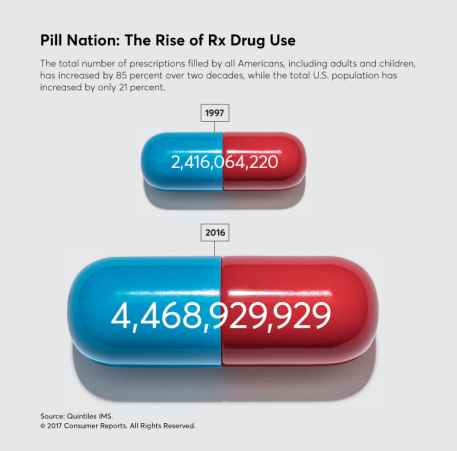 be fixed with medicine and prescriptions alone. In fact, while medication use has gone up exponentially (300% in the past 20 years alone), the rate of depression has directly gone up just as well. We haven’t solved, or even made a dent in the issue with this approach. These depressing numbers, word choice intended, can’t go on.
While it seems insurmountable to tackle the issue of society that’s eroding us from the inside out, all is not lost. Social justice activists and advocacy groups have already begun the work of enacting change. The future solution can take many forms, from community healing to policy change, strides are being taken. However, the road to a healthier youth and participatory democracy can only come once the root causes have been addressed and accepted by those plagued by it.
– Teyah Fasheh
There is a correlation between mental health issues and the LGBTQIA community. Mental disorders are often portrayed in the entertainment industry in a negative light or follow a stereotypical image, similar to the way the LGBTQIA community is represented. Those who are not portrayed in the entertainment industry feel further isolated and lack the understanding of the disorders or communities they identify with. By bringing accurate knowledge and representation of mental health issues and the LGBTQIA community to schools, news and media, organizations have allowed stigmatized topics to become less taboo.
The LGBTQIA community not only faces stigmatization and discriminatory rights but also a lack of health awareness that requires the funding of organizations for education and prevention. Social determinants such as homelessness, family rejection, unemployment and bulling along with the physical illnesses of HIV, cancer, substance abuse and the overall mental health of the community is subject to neglect due to a lack of discussion and available health insurance. About 50% of the funding for LGBTQ health is from private foundations and target specific demographics among the community based on the organization.
However, this year has marked a ground breaking movement of LGBTQIA representation in the entertainment and news industries. A greater understanding of the love, loss and joy within the LGBTQIA community results from music about gay relationships derived from rising pop-stars such as Sam Smith, Hayley Kiyoko, Troye Sivan, Janelle Monáe and Kehlani. Along with acknowledgment in the music industry, television and movies have increased in accurate depictions of the community, as well. The 2018 film, The Miseducation of Cameron Post, portrays the denial of adolescent sexuality and religious communities attempting to emotionally abuse youths through gay conversion therapy. The movie illustrates the toil it takes on one’s mental health when the community they resonate with condemns them for something they cannot choose.

Representation reached a new high when the 2018 midterm elections set a new record for the amount of women, minorities and LGBTQIA representatives within the American government. A most notable win goes to Democrat Sharice Davids for the Kansas congressional seat. She is the first lesbian Native American woman elected to Congress. Along with Davids, Democrat Jared Polis of Colorado had a successful win on November 6th, as well. He became the nation’s first openly gay governor along with Colorado’s first Jewish governor. Polis was among the multiple LGBTQIA representatives that ran for governor this year and the progression of visibility continues.
https://www.youtube.com/watch?v=DhEO6Z7qogU
Visibility and representation are so important in today’s political climate. The American public now has access to the news 24/7. Constantly reloading twitter feeds to see what the president of the free world has to say at 2 a.m., anxiously waiting to watch our favorite comedian discuss current events on their late night talk show, and viewing celebrities advocate for civil rights movements on Instagram along with an advertisement for weight-loss tea. Youth are tuned-in to the political environment more than ever before and thus their identities and stories should be reflected through democracy.
For the young people of America struggling with their identity, having representatives within their identifiable communities in the House as well as Congress creates hope and understanding. “When people are able to see something represented, they are better able to understand and grasp who those people are, and this creates an important shift in the social consciousness to include people from a range of different backgrounds.” Having portrayals of the LGBTQIA community in the government and media gives those who identify with the community a sense of affirmation and self-worth. The mental health of women, minorities, LGBTQIA and religious groups relies on the recognition that their identities matter and their voices can be heard.
Emily Salesky
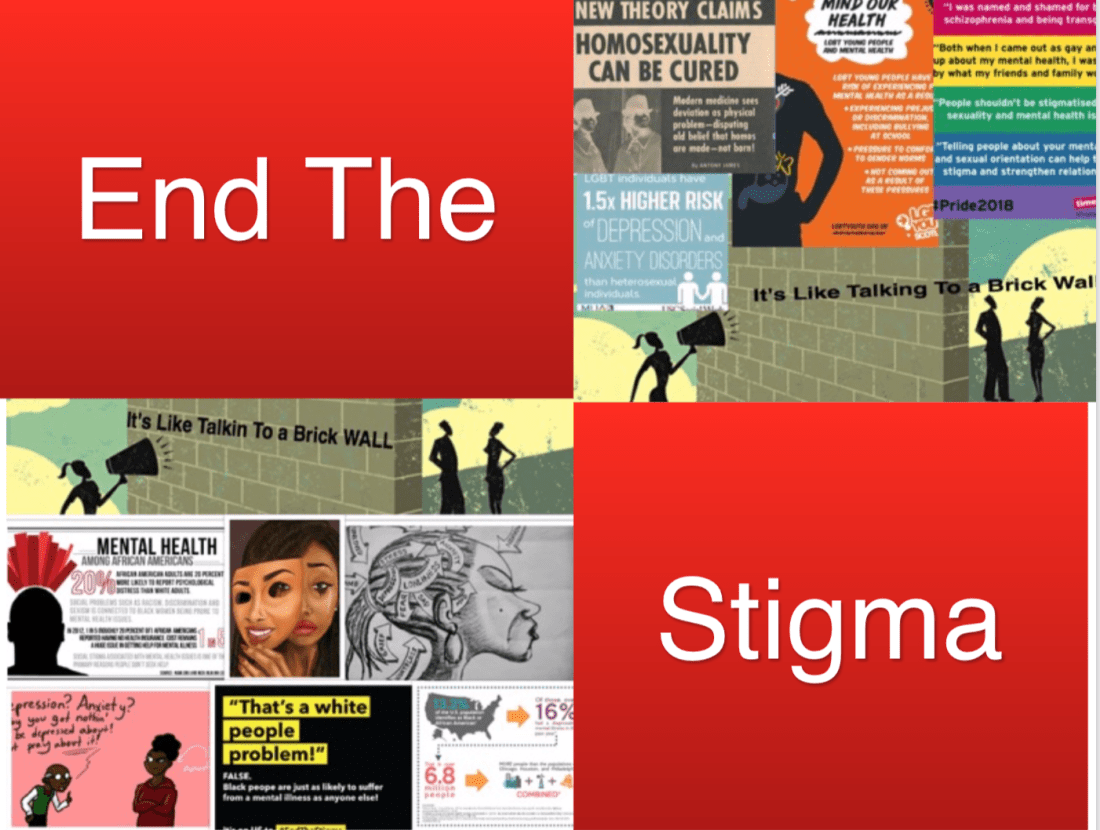
Black mental health has notoriously been denigrated through stigmas, institutions, and public opinion. “The stigma surrounding mental illness in the black community is heavy. Black people feel as though choosing to seek professional help, such as a therapist, is a sign of weakness.” Denial, shame and lack of acknowledgement has been a mechanism used outside and inside the black community when acknowledging mental issues. Furthermore, a whitewashed view of what mental health means has been the rhetoric used to imagining treatment and consequently disparities only grow.
Too often trauma is constructed in a more privileged context. Benjamin and Carolissen explores narratives of community-based counselors in low-income areas. An analysis is offered reconceptualizing trauma in relation to inequality and ongoing adversity. The authors acknowledge that without understanding the past we will continue to recreate cycles of violence and perpetuate transgenerational trauma. Understanding that adaptive responses, structural and longterm effects play a role in perpetuating cycles of violence and trauma is essential to understanding trauma is this context. Disconnection and detachment of the individual occurs when cumulative experiences of trauma lead to a strategy of survival consequently, leading to social isolation and marginalization.

Mental Health America discusses the many issues African Americans face with mental health in regards to demographics/social issues, prevalence, attitudes, treatment issues, and access/insurance. Educational materials and resources to raise further awareness about mental health are offered and focus on outreach to African American communities. Statistics that suggest 45.7 million people of the U.S. population identify as Black or African American, 6.8 million of those people has had a diagnosable mental illness in the past year. However, not may of them received adequate treatment.
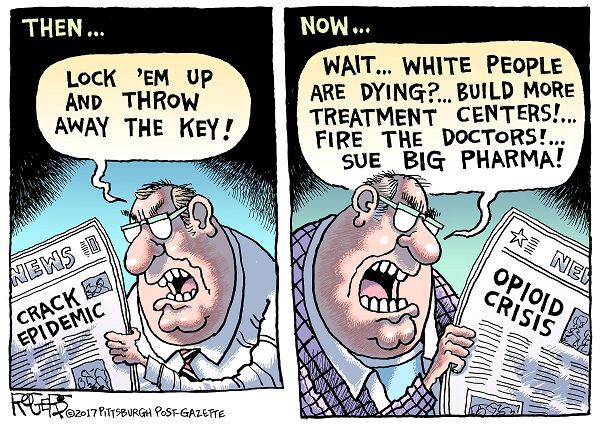
An examination of the opioid crisis and racially disparate drug policies is offered by Hansen & Netherlands. The author believes that unless existing disparities are addressed medically assisted treatment will only exacerbate inequalities. Racially stratified responses that led to penalties and criminalization for people of color but expansion of access to addiction treatment to white individuals. We see this displayed through. The War on Drugs in 1971, which was created to criminalize blackness and was really a war on poverty. Drug dealers were painted as super predators and the sole reasons for failure in neighborhoods and inner cities. Cocaine was considered to be the drug of wealthy whites. While crack was the drug of choice for poor people and was heavily criminalized. The war on drugs contributed to mass incarceration rates as blacks were given mandatory sentences and continuously disenfranchised. The war may have ended but the law and order policy, images and assumptions made during this time still existed and resulted in a genocidal effect in the black community. The laws implemented and racial disparities carried out with the three-strike and welfare policies during this time strengthened the new racial caste system and mass incarceration rates. A vital part of strengthening the war on drugs and mass incarceration rates was the allowance and operation of police with little to no oversight.
Through narratives, statistics and policies we see the ways in which historically, communities of color have experienced unique and substantial challenges in accessing mental health services. Adequate response to addiction and trauma in the black communities has also been negated. Moving forward these platforms offer solutions such as fundamental transformation of the system that acknowledges trauma in context to one’s environment. Educational outreach is also at the forefront of a root solution outlined in these articles and acknowledging existing disparities is essential to moving forward with mental health and addiction in black communities.
J.H
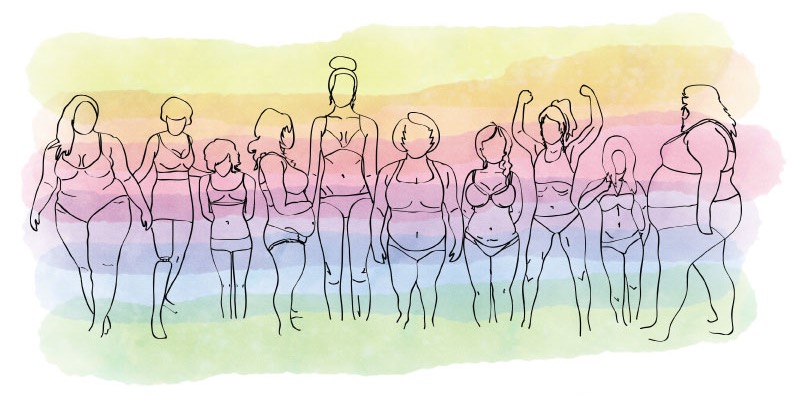
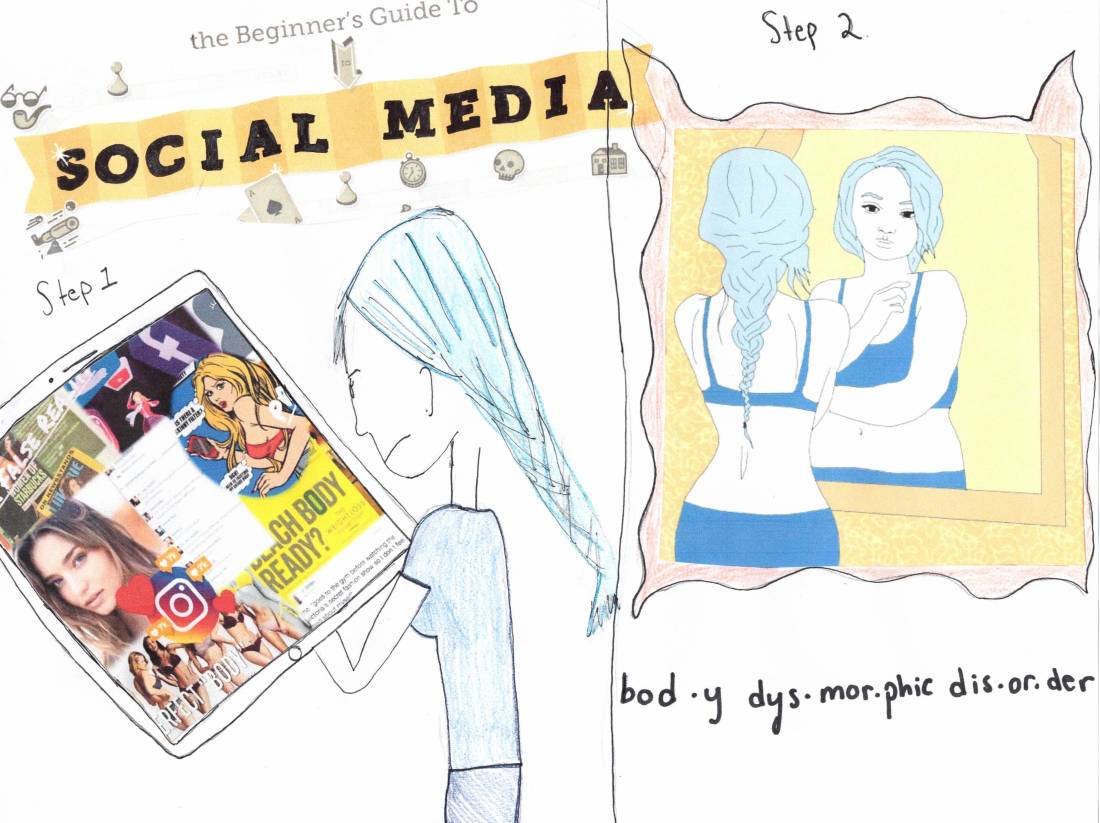
Even though millennials and generation X may seem more prepared for social media and the scrutiny that comes with it, young women’s growing minds are never prepared for comparing themselves to others. Either way, body image is something that takes years to appreciate and love, and through some soul searching, it may become a reality.
Diane Carlson Jones offers research on the correlation between body image dissatisfaction and comparisons to peers and/or media models Social Comparison and Body Image: Attractiveness Comparisons to Models and Peers Among Adolescent Girls and Boys. It is important to look at the dissatisfaction from both boys and girls, because often boys insecurities are overlooked. The target of the comparisons between appearance are often models/celebrities, because they are what young boys and girls often see on their TV’s or nowadays, social media. Attention to specific attributes is important because gender differences in the attributes contributing to attractiveness and body satisfaction have been noted. The more ideal features there are, the greater the burden is on young adults, specifically adolescent girls.
Ever since I was a young girl, I remember comparing my body to the other girls in my class. Although this did have a negative effect on my self esteem, I was also aware that every person’s body is different. The thing that was interesting to me was when I read that the more ideal features there are, the greater burden there is on young adults. I had never thought about that before, but it makes sense that if there are more features to worry about, then there is even more stress that is had by these growing adolescents. In actuality, what forces these young boys and girls to compare themselves to each other? What is the root cause of all of these comparisons?
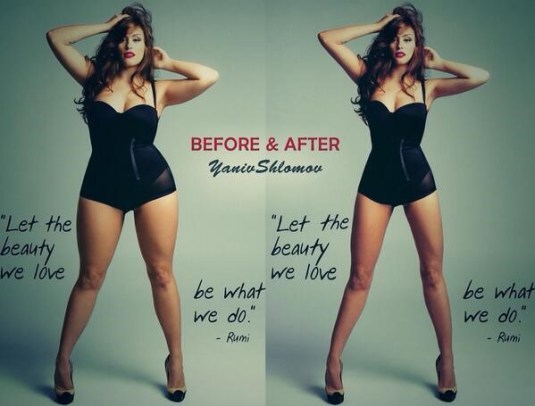
Sady Doyle focuses more so on how the upcoming generations are more prepared for a social media filled life, whereas older generations do not understand how it can seem so unbearable yet adolescents assimilate with the culture so seamlessly. Older generations of women do not understand that these young girls have known this their whole life, and if anything they grow up being prepared for what they are going to endure online. “young women have also proven to be remarkably creative in terms of finding ways to use the Internet to support each other and improve their lives. The microblogging site Tumblr, for example, is a haven for them: Its users are 51% female, with some sources reporting that half its traffic comes from people younger than 25. It’s also a hotbed for intense, diverse, literate feminist critique” (Doyle, 2001). With all of the data that shows how women are “historically condescended to, fetishized, and vulnerable to gendered violence or predation”, it is easy to just think that women are fragile on the internet, but what is not understood is that most of these women have been brought up this way, and they are stronger than most of the older people/men on the internet.
Although I can remember a life without social media, I was very young and at that age I do not think I would have even cared. Women get so much ridicule and hostility on social media, especially when it comes to the idea of body image. Fat shaming, skinny shaming- it can all be found on the different social media platforms. The difference is, we have grown up with these words being said about us, and what is forgotten is that there are other platforms that empower women rather than putting them down. We have been primed for this treatment ever since we entered the internet world, so if anyone can handle it, it is definitely women.
The shift in mens body image ideals (specifically in movies) is partly the media’s doing, but also correlates with men’s own ideals of sexuality, health, and aging. “the new bromance forged between the fitness and entertainment industries have vaporized the sense of unattainability that once enhanced these ideals” (Brodeur, 2015). There is much more media attention towards male actors gaining/losing weight for roles and towards their bodies in general. Examples of this are Chris Hemsworth’s body as Thor or even the weight loss of Jonah Hill. Both of these things are bringing more attention to the male body in the media which forces men to compare themselves without even realizing it.
This topic was something that I had never really heard about, but I was aware that it was definitely a thing. Men have always been pushed to the side because of the amount of attention that is put on women’s bodies, but as of recent men have been getting the negativity towards their body image as well. My question in all of this is, why has the attention historically always been put on women’s bodies and not mens? Why is a woman’s body so much more important to be kept in top shape than mens? This issue was not bad enough with just one gender being patronized, so another gender had to be added into the mix.
All in all, there has been talk about body image and hostility towards the subject since the beginning of time. With the recent addition of social media to the mix, there is even more room for scrutiny that is having a negative effect on each generation, every year. There is no clear answer to the problem of what we have to do to lessen this issue, but we can take different measures to help those who are insecure because of this. The most important thing is to become knowledgable about what is real and what is not, and to be proud of the body that you were born with, because there is nothing else like it.
Hannah Walsh
Providing college students with disabilities with appropriate supports is an increasing pressure placed on college services. Not only do students with documented learning differences require support and accommodation to be given equal access to the curriculum, but students who are suffering from a variety of mental health issues also need added support. As the stigmas around disabilities begins to lift, more and more students are willing to ask for the supports. They feel less shame. Can colleges fully accommodate this surge in needs? If one in four students requires academic or emotional support, how can college environments adapt to provide them with this support? Several factors complicate this matter. For one, college staff and faculty do not all have broad awareness of learning disabilities and mental health issues. Instead of recognizing the disability as such, they might attribute the quality or style of a student’s performance to laziness or “slowness.” While the stigma around disabilities lessens in the larger world, have college teachers caught up?

The problem here in part is one to do with the way we define intelligence. There are many kinds of intelligence and many different and valid approaches to learning. We still consider one kind of intelligence to be the “best”: verbal intelligence and fluency. This misconception informs a lot of teaching practice which in turns puts at a disadvantage a good number of students who have strengths in other areas. Students who are good visual learners or who need quiet and stillness to concentrate may be lost in large lecture halls. Instead of allowing these students to listen to a lecture online, for example, where they can repeat and pause a recording, they have a one chance shot to take it all in during lecture. Colleges have not yet caught up with the science of how we learn best. Students with learning disabilities should be automatically provided with easy access to audiobooks and class notes but this is often not the case. A student with a disability has to spend a number of hours getting accommodations in place just to try to equal the playing field.These hours could be better spent studying.
The stigma around disabilities probably leads to the lack of attention students learning needs are given. If these disabilities were acknowledged and spoken about more openly and seen as differences that require accommodation or modification, then the difficulties could be more readily solved. It should come as no surprise that students from higher socio-economic classes are provided with better supports at college. Their parents can afford to do extensive neuropsychological testing to pinpoint the areas where accommodations will be the most useful. Students who cannot afford to get such documentation from a doctor have to suffer it out in the classroom. Complaints against this kind of widespread discrimination are filed with the Office of Civil Rights but often to no good end. If people file more than one or two complaints they risk being dismissed entirely by the OCR. What does this tell us about fairness in education? There is none.
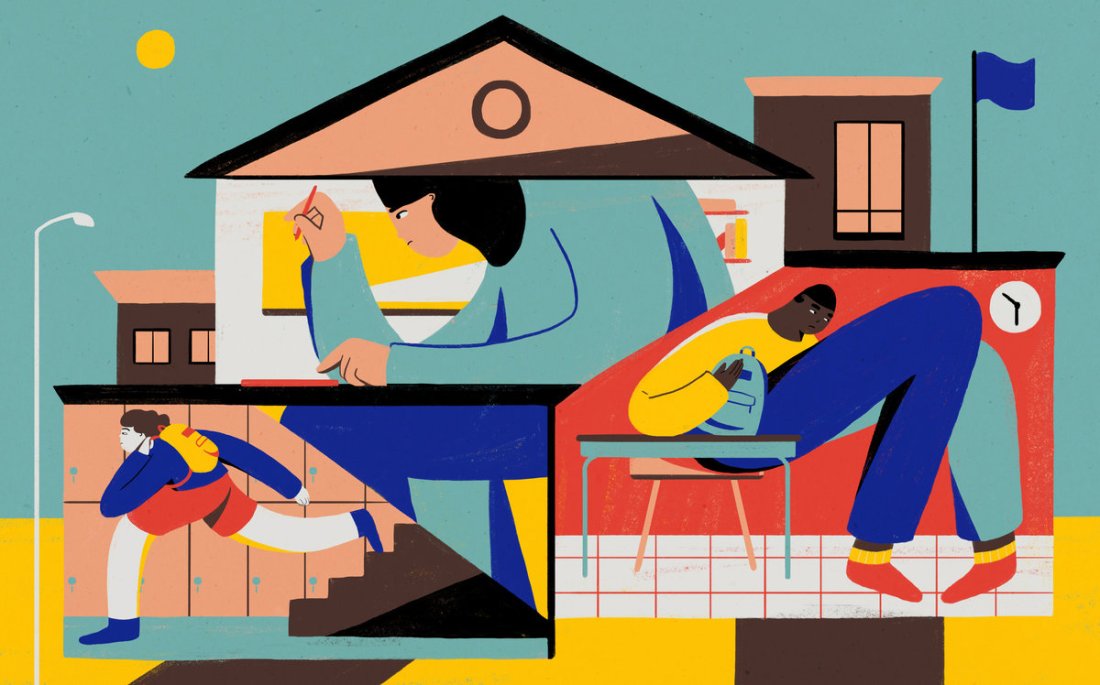
As long as students with disabilities feel shame, and are made to feel ashamed, things will not change. I recently learned the term “hegemonic masculinity” about men who are powerful and in control and who essentially rule the world. They are the tough guys that all men ideally think they should be like. I think there is also a kind of “hegemonic intelligence” which serves to demean other kinds of thinkers. This is a matter of perception. Faculty often have low expectations of students with disabilities and do not know how to provide them with appropriate challenges.These students feel at sea unless they can find a professor who perhaps knows a family member with a disability and understands what they are up against. College advisors within departments are not trained to assist students with disabilities. This is also a problem. There is not enough exchange of information between disability services and different academic departments.
On top of all these obstacles, students with disabilities must also struggle with all the other “normal” college stressors: making friends, finding a sense of belonging, getting enough sleep, eating well, peer pressure, trying to figure out how to manage time. Not only do these students have to spend more time and effort doing tasks like reading and language processing (in fact, it takes them as much as five times as long as students without learning disabilities), they also have to work in a broken and limited system. They feel stigmatized by their peers, misunderstood by their professors and neglected by the school administration. However, what gets media attention is the added financial burden these students bring to a system. It is the system and not the students who need changing.
–Uriel Tyler.
Addiction, Stress, and Stigmas Around Learning Disabilities.
Illustration by Samantha Lassman & Uriel Tyler
“Restrictions being placed on Juul are faster than gun control.”
“A juul in your hand is equivalent to having an iPhone.”
“Abled does not mean enabled. Disabled does not mean less abled.”
“You don’t improve education by demoralizing the people that have ton do the work every day”
In past generations, cigarette smoking was seen seen as a sign of “coolness” and a societal norm that everyone partook in. It is well known that the use of tobacco products has been around for many years and with any product that is produced, there is always a system of capitalism involved. It has been argued that “Big Tobacco” companies are a profit-based system based upon the notion of addiction. This system uses an addiction to nicotine to get people hooked.
As medical research has advanced, we have learned the negative effects of tobacco that has linked a system of capitalism to the cause of many deaths around the world. It is hard to break an addiction once it is started, but since we have learned the harmful effects of smoking cigarettes, many companies have created alternatives that help “solve this problem” of people being killed by these products. Juuling and e-cigarettes are presented as an alternative to help former smokers stop smoking, but at the same time they get former smokers to consume this new product by including nicotine in them.
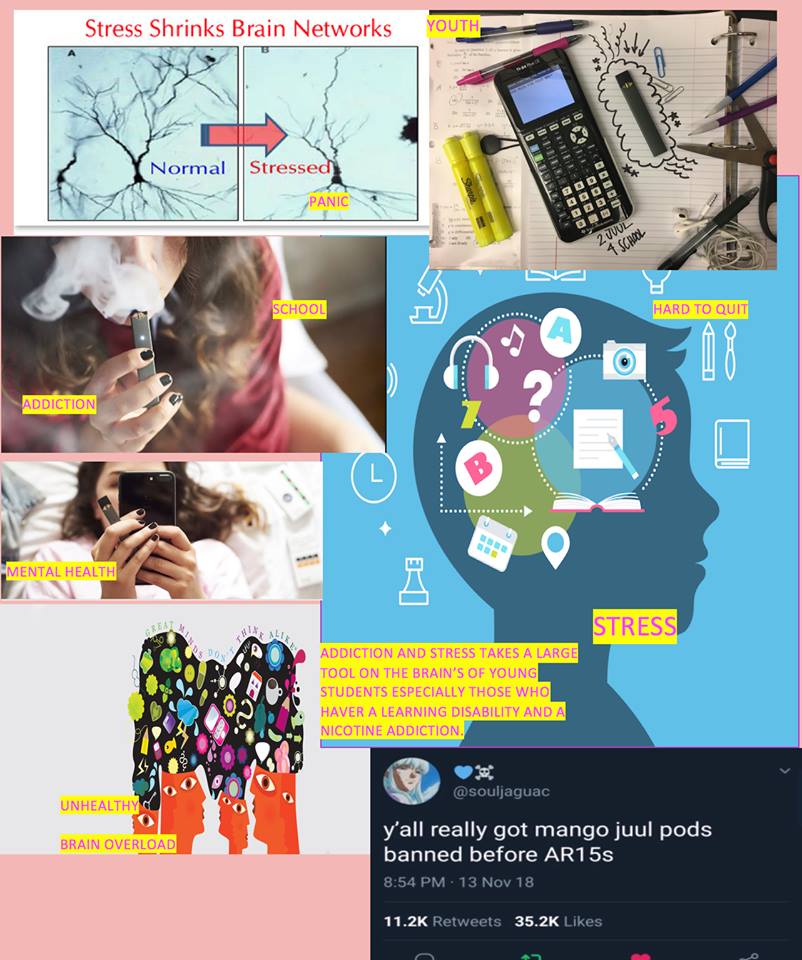
Juuls are a danger to the public health of the youth and Juuls contain the same amount, if not more nicotine than a traditional cigarette. Nicotine can ultimately harm the brain development of a growing teen.
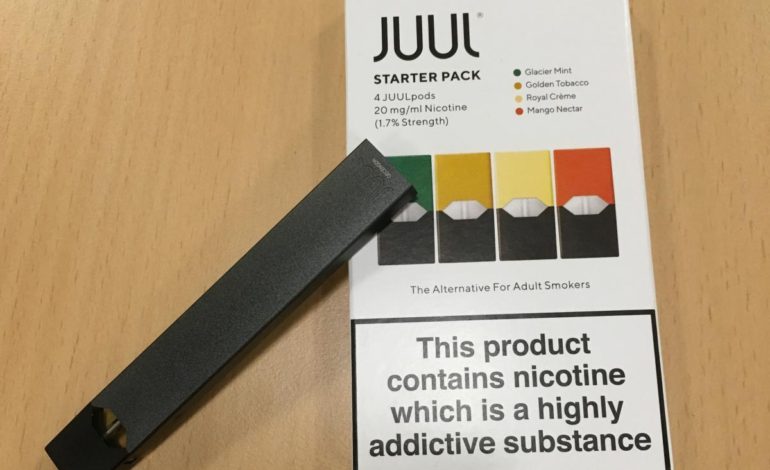
This product is not always being used for its intended purpose. While these products were specifically created to help stop an addiction, they have used marketing tactics to target young children to pick up a habit.
The e-cigarette industry has become an economic powerhouse due to the fact that they have been gaining consumers at all ages, “The e-cigarette industry has surged in popularity with juul leading the pact, increasing its revenue by 700% last year”. Juuling has become popular within youth culture and they have become an accessory of many students within schools. A Juul is your hand is equivalent to having an iPhone. Kids think that having a Juul is something that makes them look cool and that everyone is doing it. Hashtags like “#doitforjuul” and memes has become popular online. I was shocked to find out that Juul use was prevalent in my brother’s middle school bathroom, when my mom called me and asked me what a “Juul” was. She told me that the school sent a note home explaining to parents that they need to check their children’s bags for the device.
What many kids don’t realize is that juuling is a gateway to using traditional cigarettes. Juuls appeal to kids because of their their slim USB looking design, which makes it easy to hide in schools and from their parents. In addition, the vapor comes in fruit/candy flavors that appeal to kids. Many kids think it’s safe to consume because they believe they are just inhaling water vapor, but in fact they are bringing on a nicotine addiction for themselves.
The FDA has discovered data that indicates there has been an increase of consumption by youth consumers of Juuls and similar products, which ultimately leads to addiction. The FDA commissioner,Scott Gottlieb has now issued the use of Juuls as an “epidemic”. The FDA has made a recent decision to crack down on the marketing features of these products by banning the flavors of juul pods being sold in stores(with the exception of mint and menthol). In addition, the FDA will set up verification measures so that it will be hard for underage consumers to buy the flavor pods online.
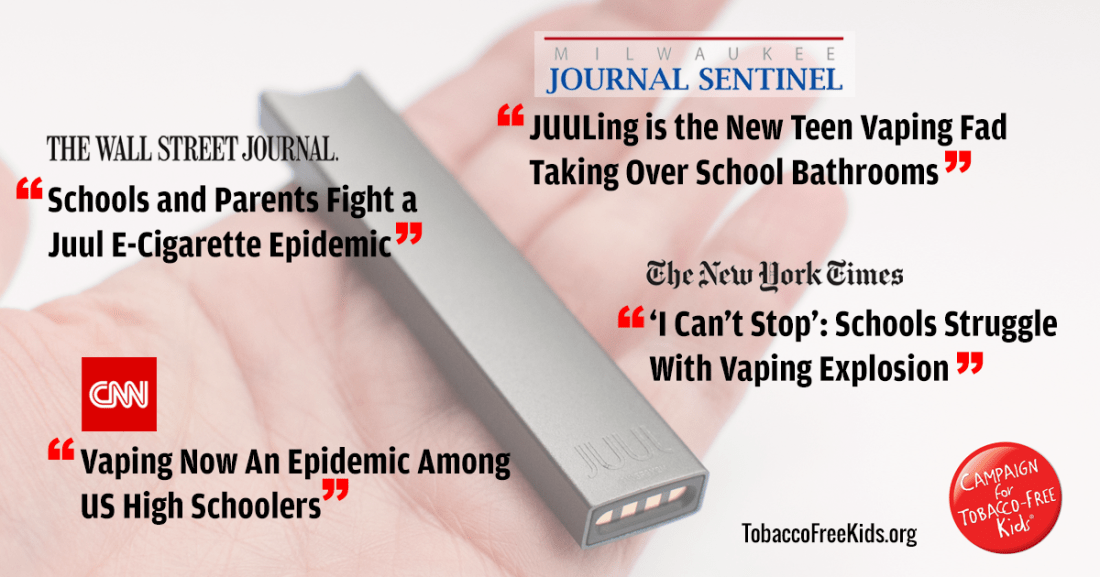
At the same time, Juul and other e-cigarette companies deny that they are directly targeting the youth and they are not responsible for the popularity of its use on social media as well as in everyday life. These companies claim that it is not their fault that non-smokers are attracted to the idea of owning a Juul.
The problem is that the industry is trying to prevent one problem (people killing themselves by cigarette us), while bringing about another problem and getting the youth involved (getting kids addicted to nicotine). There has also been backlash by the community of former smokers who are upset about the ban on the flavor pods because that’s what attracted them to switching over to using this device in the first place.
There is also a debate that can be brought up about the political implications of the government agencies taking a stand against this product and monitoring their marketing tactics towards youth.
It is now argued that restrictions being placed on Juul are faster than gun control. Yes, Juuls can lead to cigarette and tobacco use which can ultimately kill a child. However, it is being seen as an “epidemic” in schools, but what about the rise of school shootings in the past few years? The gun industry targets youth through violent video games. Why aren’t those being restricted? “Still, there is something strange, and tragic, and ultra-American, about the fact that, in many states, it will be harder for an eighteen-year-old to buy a mango Juul pod than to buy a gun”. The future question that remains is what conversations will this lead to because the Juul isn’t nearly as harmful as owning a gun or bringing a gun to school.
-S.L.
The 2018 midterm elections have set a new record for the amount of women, minorities and LGBTQIA representatives within the American government. A most notable win goes to Democrat Sharice Davids for the Kansas congressional seat. She is the first lesbian Native American woman elected to Congress. Along with Davids, Democrat Jared Polis of Colorado had a successful win on November 6th, as well. He became the nation’s first openly gay governor along with Colorado’s first Jewish governor. Polis was among the multiple LGBTQIA representatives that ran for governor this year and the progression of visibility continues.
Visibility and representation are so important in today’s political climate. The American public now has access to the news 24/7. Constantly reloading twitter feeds to see what the president of the free world has to say at 2am, anxiously waiting to watch our favorite comedian discuss current events on their late night talk show, and viewing celebrities advocate for civil rights movements on Instagram along with an advertisement for weight-lose tea. Youth are tuned-in to the political environment more than ever before and thus their identities and stories should be reflected through democracy.
For the young people of America struggling with their identity, having representatives within their identifiable communities in the House as well as Congress creates hope and understanding. “When people are able to see something represented, they are better able to understand and grasp who those people are, and this creates an important shift in the social consciousness to include people from a range of different backgrounds.” Having portrayals of the LGBTQIA community in the government and media gives those who identify with the community a sense of affirmation and self-worth. The mental health of women, minorities, LGBTQIA and religious groups relies on the recognition that their identities matter and their voices can be heard.
 Mental Health and Addictions